Skip to content

Attachment-Based Healing

Break Free from Painful Cycles in Your Relationship

Couples therapy for professionals and parents navigating generational wounds and emotional disconnect.
Emotionally-Focused Couples Therapy (EFCT) in Singapore

Break the Pattern. Heal the Wounds. Reconnect.

Feeling stuck in patterns you promised you’d never repeat?

You love each other.

You’ve tried talking it out, reading the relationship books, even watching the experts on YouTube.

But you keep ending up in the same place:
→ The same fight with different topics (money, parenting, housework, intimacy)
→ One person pursuing, the other withdrawing – and neither feeling heard
→ Resentment building despite good intentions
→ Feeling more like roommates than romantic partners
→ Unable to repair after conflict – just avoiding until “it blows over”

The fights aren’t the problem. They’re the symptom.


So, what’s actually happening? You’re both stuck in a cycle activated by the attachment wounds you each brought into the relationship.

And that cycle can be changed.

✓ Trauma-Informed Therapist
✓ EFCT-Trained by Sue Johnson Model (2025)
✓ Evening & Weekend Appointments Available

The Relationship Patterns That Brought You Here

Have you noticed these cycles in your relationship?

❌ The Same Fight on Repeat
Different topics (dishes, money, parenting, sex), but always the same underlying pattern.
You’ve tried “better communication,” but nothing sticks.

❌ The Pursue – Withdraw Dance
One partner tries to connect, talk, resolve (pursuing). The other shuts down, needs space, goes quiet (withdrawing).
The more one pursues, the more the other withdraws – leaving both feeling lonely.

❌ You Can’t Repair After Conflict
Small disagreements escalate quickly. Afterward, you either avoid each other until “it blows over” or one person apologizes just to end the tension – but the underlying hurt remains.

❌ Parenting Differences Are Tearing You Apart
You can’t agree on discipline, boundaries, or how to handle emotions. Every parenting decision becomes a fight about your relationship, not just your kids.

❌ One Partner Does All the Emotional Labour
One person notices when things are off, initiates conversations, manages everyone’s feelings, plans connection time. The other doesn’t see what needs to be done or feels criticized when they try.

❌ Intimacy Has Disappeared
Emotional connection faded first. Physical intimacy followed. Now you’re co-parents or roommates, not romantic partners—and you don’t know how to get it back.

❌ You Feel Alone, Even When You’re Together
You’re both physically present but emotionally distant. You’ve stopped reaching for each other because it feels safer to disconnect than risk more hurt.

Does this sound familiar?

If this resonates, you’re not alone.

More importantly: these patterns aren’t signs you’re incompatible.

They’re signs you’re stuck in a cycle driven by attachment wounds – and that cycle can be healed.

The question isn’t “Are we right for each other?”

The question is: “Are we willing to understand the cycle we’re stuck in, and heal it together?

That’s where Couples Therapy comes in.

Why This Keeps Happening?

The Real Problem Beneath Your Fights (And Why “Communication Skills” Aren’t Enough)

Most couples therapy focuses on teaching you to communicate better.
You learn “I statements.” Active listening. How to “fight fair.”
And it helps for a while.

But then you’re back in the same cycle. Because communication skills don’t address what’s actually happening beneath the surface.

Your fights aren’t really about the dishes, the money, the parenting schedule, or the sex.

They’re about attachment wounds. Wounds from your childhood. From past relationships. From the patterns you learned about what it means to be safe, loved, and valued.

When your attachment needs aren’t met (safety, connection, being seen), your nervous system interprets it as danger.

So you react:
→ You pursue (protest, demand, criticize) to get your partner’s attention
→ Or you withdraw (shut down, go quiet, create distance) to protect yourself from feeling attacked.

Your partner’s nervous system reacts to YOUR reaction. And the cycle deepens.

The Pursue-Withdraw Cycle (a typical scenario)
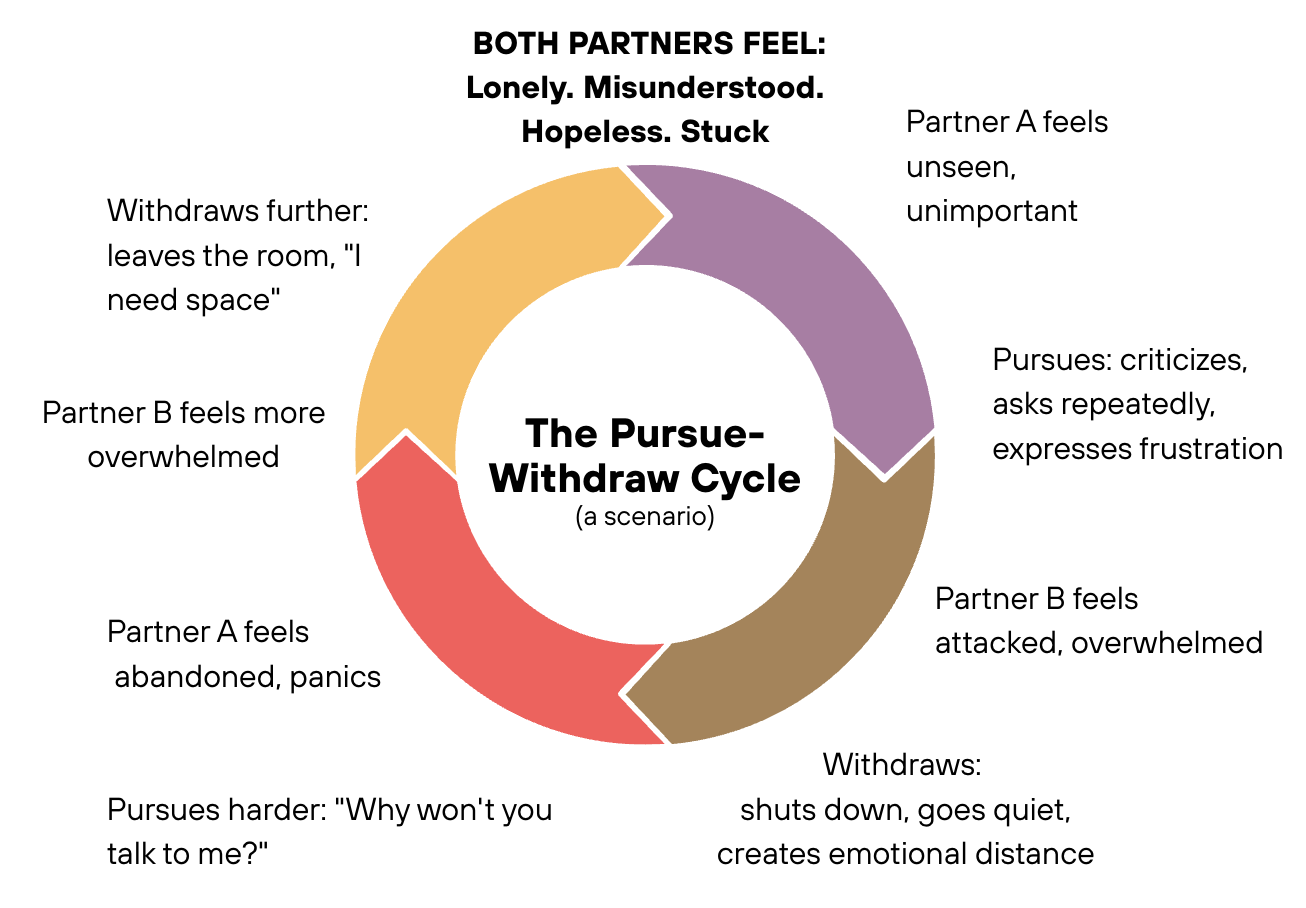
This isn’t about who’s right or wrong.
It’s about two people trying to get their needs met but activating each other’s wounds in the process.

Here’s the good news:
Once you can SEE the cycle – the dance you’re stuck in – you can interrupt it.

Once you understand the attachment wounds driving the cycle, you can heal them together.

And once you learn to repair instead of just avoiding or exploding, the relationship becomes a place of safety instead of pain. And it changes everything.


The Process

Phase 1 – De-Escalation: Seeing the Cycle

What We Do
We identify the negative cycle you’re stuck in that keeps repeating no matter what you try.

You’ll Learn:
– What triggers each of you (and why)
– How you each respond when feeling unsafe in the relationship
– How your responses inadvertently trigger each other
– The attachment fears beneath the surface (“I’m not important to you” / “I can never do anything right”)

The Goal: Stop blaming each other. Start seeing the cycle as the problem, not your partner.

What Changes:
Instead of “You always criticize me,” you’ll say, “We’re in the cycle again.”
Instead of “You never listen,” you’ll say, “I’m feeling unseen right now, and I’m scared.”

Phase 2 – Restructuring: Healing the Wounds

What We Do
We explore the deeper attachment wounds driving the cycle:
– What did you learn about love, safety, and connection in your childhood?
– What unmet needs are you bringing into this relationship?
– What do you each really need beneath the fights?

Creating new emotional interactions where both partners feel:
– Seen and valued
– Safe to be vulnerable without fear of judgment or rejection
– Able to reach for each other instead of defending against hurt

The Goal: Transform the relationship into a secure base where both partners can say, “I need you,” and trust they’ll be met with care, not criticism.

What Changes:
Instead of “I can’t tell you I’m hurting because you’ll just get defensive,” you’ll be able to say, “I’m scared I’m losing you,” and be held in that vulnerability.

Phase 3 – Consolidation: Building New Patterns

What We Do
We practice the new ways of connecting until they become your new normal, not something you only remember to do in therapy session.

You’ll Learn:
– How to reach for each other when triggered (instead of attacking or withdrawing)
– How to repair after conflict (the most important skill in any lasting relationship)
– How to co-regulate each other’s nervous systems (calming together, not escalating together)
– How to parent as a team (if applicable) from a place of secure connection, not competing wounds

The Goal: A relationship where you can mess up, repair, and grow together.
Where conflict doesn’t mean catastrophe. Where vulnerability doesn’t mean danger.

What Changes: You’ll fight less often. When you do fight, you’ll repair faster. And most importantly, you’ll feel emotionally safe with each other again.

The Timeline

It typically takes 10-20 sessions, though every couple is different. Some couples feel significant shifts in the first 3-5 sessions (once they can see the cycle clearly). Deeper healing, transforming attachment wounds into secure connection, takes longer.

We’ll check in regularly about progress and adjust the approach as needed. If you’re not feeling movement after 5-6 sessions, we’ll talk openly about whether this is the right fit.


Who This Therapy Serves (And Who It Doesn’t)

This Therapy Is For You If:

✓ You’re both committed to the relationship (even if you’re not sure it will work) and willing to do the vulnerable work of healing
✓ You want to understand the deeper patterns, not just “fix” surface-level communication issues
✓ You’re navigating parenting differences, emotional labor imbalances, or disconnection after having children
✓ You’re willing to look at your own wounds, not just focus on what your partner is doing wrong
✓ You’re working parents or busy professionals who need therapy that fits demanding schedules (we offer evening/weekend sessions and online options)
✓ One or both of you experienced childhood trauma (ACEs), and you can see how those patterns show up in your relationship today

This Therapy Is NOT Right If:

✗ There is active domestic violence or abuse in the relationship (safety must be addressed first through individual therapy and safety planning)
✗ One partner is dealing with active, untreated addiction that’s significantly impacting the relationship (individual treatment needed first, then couples work)
✗ One partner is actively engaged in an ongoing affair and not willing to end it or commit to rebuilding trust (affairs can be healed, but only after commitment to the relationship)
✗ One or both partners have already decided to end the relationship (that’s valid, but the therapy focus would shift to conscious uncoupling or co-parenting, not relationship repair)
✗ You’re looking for someone to tell your partner they’re wrong or “fix them” (Couples therapy doesn’t take sides; it addresses the cycle between you)

Not Sure If This Is Right For You?

That’s completely normal. Most couples come to therapy feeling uncertain, scared, hopeful, and defensive all at once.

Book your first session – we’ll spend time in the initial assessment understanding your unique situation, what you’ve already tried, and whether this is the right approach for where you are now. If it’s not the right fit, I’ll tell you honestly and help you find what you need.


EFCT-Trained Couples Therapist in Singapore

Meet Your Therapist, Corrine

Hi, I’m Corrine Lin and I work with parents and couples because I believe the relationship can be the place where healing happens. Not just individual healing (though that’s part of it), but healing together to transform the attachment wounds you each brought into the partnership into secure connection, repair, and resilience.

I trained in Emotionally-Focused Couples Therapy (EFCT) with the Singapore EFT community in 2025, building on my foundation in trauma-informed care, attachment-based work, and somatic-informed interventions. But my commitment to couples therapy goes deeper than credentials.

I’ve walked with people navigating relationship challenges while carrying their own unhealed wounds. 

I recognize what it’s like to parent as a team when you’re both triggered by different things.

I see what it’s like to love someone deeply and still hurt each other – and to wonder if repair is even possible.

And I know that it is. When both partners are willing to see the cycle. To understand the wounds. To reach for each other differently. That’s the work I’m here to support

In our work together, I won’t tell you who’s “right” or “wrong.” Instead, I’ll help you both:

  • – See the cycle you’re stuck in (the pursue-withdraw dance, the emotional disconnection, the pattern beneath the fights)
  • – Understand the attachment wounds driving it (what you each learned about love, safety, and connection)
  • – Create new interactions where both of you feel safe, seen, and valued
  • – Learn to repair – because repair is more important than never fighting

In sessions, we apply
→ Integrative trauma-informed care – Understanding how your past (childhood, family patterns, past relationships) shows up in your partnership today
→ Somatic-informed interventions – Working with both your nervous systems to help you regulate together, not just react to each other
→ Transactional Analysis (TA) – Mapping the internal and relational roles (Parent, Adult, Child) so you can consciously step out of old scripts and reclaim your authentic self.
→ Cultural sensitivity – Understanding family dynamics, generational expectations, and cultural pressures in Asian context
→ Parenting integration – If you have children, we address how to parent as a team while healing your own attachment wounds

Training & Credentials:

  • EFCT-Trained (Singapore EFT, 2025 – Sue Johnson Model)
  • Master of Counselling (Advanced), Swinburne University of Technology
  • Certified Transactional Analysis Practitioner (TAP), USATAA
  • Full Clinical Member, Singapore Association of Counselling (SAC)
  • Member, Transactional Analysis Association (TAA) Singapore

Languages: Fluent in English and Mandarin. Conversational in Malay and dialects (Cantonese, Hakka)
Sessions can be conducted in English, Mandarin, or a blend of both.

Experience working with individuals, youths, and couple – in working with:
→ Working parents navigating disconnection and parenting conflicts
→ High-achieving professionals dealing with relationship burnout
→ Couples healing from breach of trust, emotional disconnection, or attachment wounds


💖 The Foundation: Your First Session

Your initial 75-90 minute session is dedicated to understanding your unique history and relationship dynamic.

You’ll openly explore how your connection evolved, the patterns you currently struggle with, and the attachment experiences that shape how you relate.

What you gain: You’ll leave with an understanding of the negative cycle you’re caught in and a roadmap for the EFCT work ahead.

This session requires both partners to be present, as healing happens in the space between you.

🗺️ The Process: Ongoing Sessions

EFCT is a powerful, integrative approach that focuses on emotional connection and repair. Sessions are typically 50-75 minutes, held weekly or bi-weekly, and can be conducted in-person or online.

What you’ll work on: You’ll learn to de-escalate the cycle of blame and withdrawal, explore the attachment wounds that fuel your fights, and create new emotional interactions where you reach for each other instead of defending or shutting down. Practicing repair becomes your most critical skill for change.

🌱 The Commitment: Timeline and Transformation

Lasting change is possible with consistent commitment. While every couple is unique, the process typically involves 10-20 sessions structured in three phases:

De-escalation: You start seeing the cycle clearly and feel less reactive.
Restructuring: You engage in deeper healing of past wounds and begin creating new, secure patterns of interaction.
Consolidation: You solidify these positive changes and integrate your new connection into daily life.

Healing happens in the small, consistent moments (noticing the cycle, choosing repair, reaching differently).
You are encouraged to commit to showing up consistently, even amidst busy lives.

✨ Your Access to Healing

Designed for working parents and high-achieving professionals, we offer flexible scheduling including online, evening, and weekend appointments to ensure you can truly make space for your healing.

Your Commitment to your relationship and peace of mind involves session fees. We offer package options, and a limited number of sliding scale spots are available, ensuring financial access is not an obstacle to beginning this journey of repair.


Frequently Asked Concerns

Is this online or in-person?

Both options are available:

Online Sessions:

  • Join from the privacy and comfort of your space
  • No commute time (especially helpful for busy schedules)
  • Equally effective as in-person for EFCT work
  • Flexible scheduling (evening/weekend options)
  • Both partners can join from the same location preferably or separately if needed

In-Person Sessions:

  • Face-to-face connection in Singapore
  • Some couples prefer the dedicated physical space
  • Same therapeutic effectiveness

Research shows online couples therapy is just as effective as in-person – what matters most is your commitment to the process and consistency in showing up.

We can discuss which format feels right for you when you book.

Can we switch between online and in-person sessions?

Yes, absolutely.

Many couples do a mix:

  • In-person when schedules allow
  • Online during busy work weeks or when childcare is challenging

Consistency in the work matters more than consistency in format. We’ll track your progress either way.

Do both partners need to want to be there?

Partners who are committed to the process creates the best outcomes.

But it’s completely normal for one person to be more hesitant or skeptical at first. If one partner is willing to try (even reluctantly), that’s often enough to start.

What won’t work:

  • One partner forced into therapy completely against their will
  • One partner already decided the relationship is over (unless the goal shifts to conscious uncoupling)

If you’re unsure where you both are, book the first session – we’ll assess together whether EFCT is the right fit for your current situation.

How is EFCT different from regular couples therapy?

Most couples therapy focuses on teaching communication skills and conflict resolution techniques—”I statements,” active listening, how to “fight fair.”

EFCT goes deeper. It addresses the attachment wounds and emotional needs driving your fights. Instead of learning “how to argue better,” you learn how to create secure emotional connection—so the fights happen less often, repair happens more easily, and you feel emotionally safe with each other again.

EFCT is one of the most researched and effective models for couples therapy, with 70-75% of couples moving from distress to recovery, and changes that last long-term.

How long does EFCT take?

Typically 10-20 sessions over 3-6 months, though every couple is different.

What to expect:

  • Phase 1 (De-escalation): You’ll start seeing the cycle clearly and feeling less reactive
  • Phase 2 (Restructuring): Deeper attachment healing, creating new emotional interactions
  • Phase 3 (Consolidation): Solidifying changes, building resilience

Some couples feel shifts quickly (within the first month of weekly sessions).
Deeper healing takes longer (transforming lifelong attachment patterns requires time and consistent practice).

We’ll check in regularly about progress. If you’re not feeling movement after 5-6 sessions, we’ll talk openly about whether adjustments are needed or if a different approach might serve you better.

Do you offer free consultation before booking?

Yes, we do offer 15 minutes callback for enquiries. For couples therapy, the first session itself serves as both an assessment and the beginning of therapy.

Rather than a brief consultation call, I prefer to use the full session time to:

  • Deeply understand your relationship history and current challenges
  • Begin identifying the cycle you’re stuck in
  • Give you a real experience of what EFCT feels like
  • Assess together whether this approach is the right fit

If after the first session you feel this isn’t right for you, I’ll provide referrals to other therapists or approaches that might serve you better. This ensures we have adequate time to truly understand your situation and begin the work – not just a surface-level conversation.

How much does EFCT couples therapy cost?

Entering this work is a commitment – an investment in your relationship’s foundation, addressing the roots of disconnection rather than repeatedly managing surface-level conflicts. For many, the cost of therapy is significantly less than the ongoing emotional toll of staying stuck, or the potential financial and emotional costs of separation.

Session Fees:
S$300 per 90−minute session

For couples ready to accelerate their healing and commit to a defined journey, packages are available that offer a streamlined approach and greater consistency in your growth. We can discuss the options that best support your goals during our initial deep dive

Sliding Scale Spots: I offer a limited number of sliding scale spots for couples who are experiencing temporary financial constraints. I believe financial barriers should not prevent you from accessing the healing you need. Please feel encouraged to discuss what’s possible when you reach out to book your first session.

What’s your cancellation policy?

24-Hour Notice Required:
If you need to cancel or reschedule, please provide at least 12 hours’ notice. For cancellations with less than 12 hours’ notice, a S$100 fee will be applied.

Emergencies:
True emergencies (sudden illness, family crisis) are handled with compassion and flexibility – just communicate to us as soon as possible.

Why this matters:
Your session time is reserved exclusively for you. Late cancellations mean another couple can’t access that slot, and it impacts the continuity of your healing work.

Commitment to the process (showing up consistently even when it’s hard) is a key part of EFCT’s effectiveness.

We have demanding jobs and young kids. Do we have time for this?

Many of my clients are working parents and busy professionals with packed schedules.

You don’t need hours of free time, you need commitment to showing up consistently, even if that’s just 50-75 minutes once a week or every two weeks.

Flexible Options:

  • Evening appointments (up to 8 PM)
  • Weekend sessions
  • Online therapy (no commute – join from home after kids are in bed)
  • In-person sessions in Singapore for those who prefer face-to-face

The real work happens in the small moments between sessions – noticing the cycle when it starts, choosing repair over avoidance, reaching for each other differently.

If your relationship matters to you, you’ll make the time. We’ll work together to make it fit your life.

Can we bring our kids to sessions?

Couples therapy sessions are designed for both partners only, in order to create space to focus on the relationship dynamic without distractions.

However:

  • Childcare concerns? We offer online sessions so you can attend from home after bedtime, or during school hours
  • Family therapy needs? If there are parenting or family dynamics that need attention, we can discuss integrating family sessions separately, or I can provide referrals to family therapists

The couples work focuses on your attachment bond which ultimately benefits your children by creating a more secure family foundation.

What happens if only one of us can make a session?

EFCT is most effective when both partners attend consistently since we’re working on the dynamic between you, not just individual issues.

However, life happens:

  • If one partner has an unavoidable conflict (work travel, illness, childcare emergency), we can:
    • Reschedule when both can attend
    • Or proceed with one partner for that session (focusing on their individual attachment work, which still benefits the relationship)

Frequent one-partner attendance makes EFCT less effective. If scheduling is consistently challenging, let’s explore together – perhaps adjusting session frequency or finding times that work better for both of you.

Will our information be kept confidential?

Everything shared in therapy is strictly confidential and protected under Singapore’s ethical guidelines for counselling.

We will not disclose:

  • That you’re attending therapy
  • What you discuss in sessions
  • Any information about your relationship

Exceptions (legally required to break confidentiality):

  • Imminent risk of harm to self or others
  • Suspected child abuse or neglect
  • Court order requiring disclosure

Your privacy and safety are paramount.

What if we’re not sure we want to stay together?

That’s an honest and valid place to be.

EFCT can help in two ways:

1. If you’re genuinely unsure whether to stay or leave, EFCT can help you:

  • Understand what’s actually broken (the cycle) vs. whether you’re incompatible
  • See if the relationship can shift once you address the attachment wounds
  • Make a more informed decision, not from a place of pain and reactivity, but from clarity

Many couples enter therapy unsure if they want to stay and through understanding the cycle and healing the wounds, they rediscover the connection they thought was lost.

2. If through the process it becomes clear that separation is the healthiest choice, EFCT principles can help you:

  • End the relationship with respect and understanding (not blame and bitterness)
  • Co-parent effectively if you have children
  • Learn from the relationship patterns so you don’t repeat them in future relationships

The first session will help clarify where you both are and what approach makes sense.

What if there’s been domestic violence or abuse?

Safety always comes first.

If there is active domestic violence or abuse (physical, emotional, financial, sexual), couples therapy is not appropriate until safety is established.

What’s needed instead:

  • Individual safety planning for the person experiencing abuse
  • Individual therapy for both partners (especially trauma-informed care for the survivor)
  • Potentially involvement of domestic violence support services
  • Only after safety is established and the abusive behaviour has stopped can couples therapy be considered

If you’re unsure whether your relationship involves abuse, or if you’re experiencing violence, please reach out. I can help you assess the situation and connect you with appropriate resources.

Resources:
📞 TRANS SAFE Centre: 6449-9088
📞 National Anti-Violence and Sexual Harassment Helpline (NAVH): 1800-777-0000 (24 hours)
📞 AWARE’s Sexual Assault Care Centre: 6779-0282 (Mon – Fri, 10am – 6pm)

What if one or both of us has childhood trauma (ACEs)?

That’s actually common, and it’s exactly what EFCT is designed to address.

The patterns you learned in childhood about safety, connection, trust, and worthiness show up in your adult relationships, often in the form of the pursue-withdraw cycle.

For example:

  • If you learned “my needs don’t matter,” you might withdraw to avoid burdening your partner
  • If you learned “love is conditional and I have to fight for it,” you might pursue intensely when feeling disconnected

EFCT helps you understand those patterns and heal them together, so you’re not reacting from your wounds but responding from secure connection.

If one partner needs more individual trauma therapy alongside couples work, we can discuss integrating individual sessions or appropriate referrals.

What if there’s been infidelity or betrayal?

EFCT can be highly effective for couples healing from infidelity under certain conditions:

✓ This can work if:

  • The affair has completely ended
  • The partner who had the affair is fully committed to rebuilding trust
  • Both partners are willing to understand how the disconnection happened (not to excuse it, but to heal it)
  • Both are committed to staying in the relationship

✗ This won’t work if:

  • The affair is ongoing or contact continues
  • One partner is not committed to the relationship
  • There is active lying or deception continuing

The EFCT approach to infidelity:
We address the affair as both a symptom of the broken attachment bond AND a violation that requires repair. We work on understanding the cycle of disconnection that preceded it, while also processing the betrayal trauma and rebuilding trust through new, consistent interactions.

This is long, hard work but it’s possible when both partners are willing.

Let’s talk about your specific situation during the first session.

What if one partner is dealing with addiction?

If one partner is struggling with active, untreated addiction (alcohol, substances, gambling, etc.) that significantly impacts the relationship, individual addiction treatment needs to happen first.

What’s needed:

  • Individual treatment for the addiction (detox, rehab, support groups, addiction therapy)
  • Stabilization period (typically 3-6 months of consistent sobriety)
  • Then, couples therapy can address the relationship wounds, both those caused by the addiction and those that may have contributed to it

If addiction is in recovery/remission:
If one partner is in active recovery (attending AA/NA, working with a sponsor, maintaining sobriety), EFCT can be highly beneficial – addressing the attachment wounds and rebuilding trust alongside the recovery journey.

Let’s discuss your specific situation when you book.


Take the Next Step

You’ve been stuck in this cycle long enough.
You’ve tried talking it out. Reading the books. Watching the relationship experts. But you keep ending up in the same place:

  • The same fights with different topics
  • The same pursue-withdraw dance
  • The same loneliness, even when you’re together

You’re not incompatible.
You’re not broken.
Your relationship isn’t beyond repair.

You’re stuck in a cycle driven by attachment wounds and that cycle can be healed.

And it requires:

  • Both of you willing to see the cycle (not just blame each other)
  • Both of you willing to understand the wounds beneath the fights
  • Both of you willing to reach for each other differently
  • Both of you willing to do the vulnerable, courageous work

This is hard. This is uncomfortable. This is some of the most important work you’ll ever do.
And you don’t have to do it alone.


What Happens When You Book The Session

Step 1: Book Your Session
Choose a time and session format that works for both of you (evening/weekend/online options available).

Step 2: Confirmation & Preparation
You’ll receive a confirmation email with:
▸ Session details (date, time)
▸ Intake forms to complete before your first session (helps us use time efficiently)
▸ What to expect in the first session

Step 3: Your First EFCT Session (75-90 minutes)
We’ll explore:
▸ Your relationship story
▸ Current patterns and challenges
▸ Individual attachment histories
▸ Whether EFCT is the right fit
▸ The roadmap ahead

Step 4: Begin the Healing Journey
If EFCT feels right, we’ll schedule ongoing sessions and begin the work of:
▸ De-escalating the cycle
▸ Healing attachment wounds
▸ Creating secure connection
▸ Learning to repair


Flexible Scheduling

Available Times:
▸ Weekday evenings (up to 8:00 PM)
▸ Saturday & Sunday sessions
▸ Online & in-person options
▸ All sessions are by-appointment only

Languages: English, Mandarin, or a blend of both

Both Partners Required:
EFCT works by addressing the dynamic between you, both partners should attend all sessions when possible.


Still Have Questions?

Email: hello@clariepsychotherapy.com
We typically respond within 48 hours.

You’re not alone in this struggle.

Many couples have walked this path – feeling stuck, scared, hopeful, and uncertain all at once.
EFCT has a 70-75% success rate for helping couples move from distress to secure connection.

The question isn’t whether your relationship can be healed.
The question is: Are you both willing to do the work?
If the answer is yes – even an uncertain yes at this moment – that’s enough to start.


Contact

CLARiE Psychotherapy
Singapore

📧 hello@clariepsychotherapy.com

🌐 www.clariepsychotherapy.com

Office Hours

Mon – Fri: 10:00 AM – 9:00 PM
Weekends & PH: By Appointment

Online & in-person sessions available by-appointment only

Session Location

City Hall / Novena

The Cycle Ends When You Decide It Does

You can close this page and return to the same pattern – the same fights, the same disconnection, the same loneliness. Or you can take one brave step toward healing and see what’s possible when two people choose to heal together. Your relationship is worth it. You’re worth it.

You’re Not Broken. You’re Stuck in a Cycle. Let’s Change It Together.
Breaking Cycles. Building Connection. One Session at a Time.


Attachment-Based Healing

Break Free from Painful Cycles in Your Relationship

Couples therapy for professionals and parents navigating generational wounds and emotional disconnect.

Emotionally-Focused Couples Therapy (EFCT) in Singapore

Break the Pattern. Heal the Wounds. Reconnect.

Feeling stuck in patterns you promised you’d never repeat?

You love each other.

You’ve tried talking it out, reading the relationship books, even watching the experts on YouTube.

But you keep ending up in the same place:
→ The same fight with different topics (money, parenting, housework, intimacy)
→ One person pursuing, the other withdrawing – and neither feeling heard
→ Resentment building despite good intentions
→ Feeling more like roommates than romantic partners
→ Unable to repair after conflict – just avoiding until “it blows over”

The fights aren’t the problem. They’re the symptom.


So, what’s actually happening? You’re both stuck in a cycle activated by the attachment wounds you each brought into the relationship.

And that cycle can be changed.

✓ Trauma-Informed Therapist
✓ EFCT-Trained by Sue Johnson Model (2025)
✓ Evening & Weekend Appointments Available

The Relationship Patterns That Brought You Here

Have you noticed these cycles in your relationship?

❌ The Same Fight on Repeat
Different topics (dishes, money, parenting, sex), but always the same underlying pattern.
You’ve tried “better communication,” but nothing sticks.

❌ The Pursue – Withdraw Dance
One partner tries to connect, talk, resolve (pursuing). The other shuts down, needs space, goes quiet (withdrawing).
The more one pursues, the more the other withdraws – leaving both feeling lonely.

❌ You Can’t Repair After Conflict
Small disagreements escalate quickly. Afterward, you either avoid each other until “it blows over” or one person apologizes just to end the tension – but the underlying hurt remains.

❌ Parenting Differences Are Tearing You Apart
You can’t agree on discipline, boundaries, or how to handle emotions. Every parenting decision becomes a fight about your relationship, not just your kids.

❌ One Partner Does All the Emotional Labour
One person notices when things are off, initiates conversations, manages everyone’s feelings, plans connection time. The other doesn’t see what needs to be done or feels criticized when they try.

❌ Intimacy Has Disappeared
Emotional connection faded first. Physical intimacy followed. Now you’re co-parents or roommates, not romantic partners—and you don’t know how to get it back.

❌ You Feel Alone, Even When You’re Together
You’re both physically present but emotionally distant. You’ve stopped reaching for each other because it feels safer to disconnect than risk more hurt.

Does this sound familiar?

If this resonates, you’re not alone.

More importantly: these patterns aren’t signs you’re incompatible.

They’re signs you’re stuck in a cycle driven by attachment wounds – and that cycle can be healed.

The question isn’t “Are we right for each other?”

The question is: “Are we willing to understand the cycle we’re stuck in, and heal it together?

That’s where Couples Therapy comes in.

Why This Keeps Happening?

The Real Problem Beneath Your Fights (And Why “Communication Skills” Aren’t Enough)

Most couples therapy focuses on teaching you to communicate better.

You learn “I statements.”

Active listening.

How to “fight fair.”

And it helps for a while.

But then you’re back in the same cycle.

Because communication skills don’t address what’s actually happening beneath the surface.

Your fights aren’t really about the dishes, the money, the parenting schedule, or the sex.

They’re about attachment wounds.

Wounds from your childhood. From past relationships. From the patterns you learned about what it means to be safe, loved, and valued.

When your attachment needs aren’t met (safety, connection, being seen), your nervous system interprets it as danger.

So you react:

→ You pursue (protest, demand, criticize) to get your partner’s attention

→ Or you withdraw (shut down, go quiet, create distance) to protect yourself from feeling attacked.

Your partner’s nervous system reacts to YOUR reaction.

And the cycle deepens.

The Pursue-Withdraw Cycle (a typical scenario)

This isn’t about who’s right or wrong.

It’s about two people trying to get their needs met but activating each other’s wounds in the process.

Here’s the good news:

Once you can SEE the cycle – the dance you’re stuck in – you can interrupt it.

Once you understand the attachment wounds driving the cycle, you can heal them together.

And once you learn to repair instead of just avoiding or exploding, the relationship becomes a place of safety instead of pain. And it changes everything.


The Process

Phase 1 – De-Escalation: Seeing the Cycle

What We Do
We identify the negative cycle you’re stuck in that keeps repeating no matter what you try.

You’ll Learn:
– What triggers each of you (and why)
– How you each respond when feeling unsafe in the relationship
– How your responses inadvertently trigger each other
– The attachment fears beneath the surface (“I’m not important to you” / “I can never do anything right”)

The Goal: Stop blaming each other. Start seeing the cycle as the problem, not your partner.

What Changes:
Instead of “You always criticize me,” you’ll say, “We’re in the cycle again.”
Instead of “You never listen,” you’ll say, “I’m feeling unseen right now, and I’m scared.”

Phase 2 – Restructuring: Healing the Wounds

What We Do
We explore the deeper attachment wounds driving the cycle:
– What did you learn about love, safety, and connection in your childhood?
– What unmet needs are you bringing into this relationship?
– What do you each really need beneath the fights?

Creating new emotional interactions where both partners feel:
– Seen and valued
– Safe to be vulnerable without fear of judgment or rejection
– Able to reach for each other instead of defending against hurt

The Goal: Transform the relationship into a secure base where both partners can say, “I need you,” and trust they’ll be met with care, not criticism.

What Changes:
Instead of “I can’t tell you I’m hurting because you’ll just get defensive,” you’ll be able to say, “I’m scared I’m losing you,” and be held in that vulnerability.

Phase 3 – Consolidation: Building New Patterns

What We Do

We practice the new ways of connecting until they become your new normal, not something you only remember to do in therapy session.

You’ll Learn:
– How to reach for each other when triggered (instead of attacking or withdrawing)
– How to repair after conflict (the most important skill in any lasting relationship)
– How to co-regulate each other’s nervous systems (calming together, not escalating together)
– How to parent as a team (if applicable) from a place of secure connection, not competing wounds

The Goal: A relationship where you can mess up, repair, and grow together.
Where conflict doesn’t mean catastrophe. Where vulnerability doesn’t mean danger.

What Changes: You’ll fight less often. When you do fight, you’ll repair faster. And most importantly, you’ll feel emotionally safe with each other again.

The Timeline

It typically takes 10-20 sessions, though every couple is different. Some couples feel significant shifts in the first 3-5 sessions (once they can see the cycle clearly). Deeper healing, transforming attachment wounds into secure connection, takes longer.

We’ll check in regularly about progress and adjust the approach as needed. If you’re not feeling movement after 5-6 sessions, we’ll talk openly about whether this is the right fit.

Ready to Break the Cycle? Book Your Session Today

Couples holding hands

Who This Therapy Serves (And Who It Doesn’t)

This Therapy Is For You If:

✓ Both of you are committed to the relationship (even if you’re not sure it will work) and willing to do the vulnerable work of healing

✓ You want to understand the deeper patterns, not just “fix” surface-level communication issues

✓ You’re navigating parenting differences, emotional labor imbalances, or disconnection after having children

✓ Both of you are working parents or busy professionals who need therapy that fits demanding schedules (we offer evening/weekend sessions and online options)

✓ You’re willing to look at your own wounds, not just focus on what your partner is doing wrong

✓ One or both of you experienced childhood trauma (ACEs), and you can see how those patterns show up in your relationship today

This Therapy Is NOT Right If:

✗ There is active domestic violence or abuse in the relationship (safety must be addressed first through individual therapy and safety planning)

✗ There is active, untreated addiction that’s significantly impacting the relationship (individual treatment needed first, then couples work)

✗ One partner is actively engaged in an ongoing affair and not willing to end it or commit to rebuilding trust (affairs can be healed, but only after commitment to the relationship)

✗ One or both partners have already decided to end the relationship (that’s valid, but the therapy focus would shift to conscious uncoupling or co-parenting, not relationship repair)

✗ You’re looking for someone to tell your partner they’re wrong or “fix them” (Couples therapy doesn’t take sides; it addresses the cycle between you)

Not Sure If This Is Right For You?

That’s completely normal. Most couples come to therapy feeling uncertain, scared, hopeful, and defensive all at once.

Book your first session – we’ll spend time in the initial assessment understanding your unique situation, what you’ve already tried, and whether this is the right approach for where you are now. If it’s not the right fit, I’ll tell you honestly and help you find what you need.

Learn more


EFCT-Trained Couples Therapist in Singapore

Meet Your Therapist, Corrine

Hi, I’m Corrine Lin and I work with parents and couples because I believe the relationship can be the place where healing happens. Not just individual healing (though that’s part of it), but healing together to transform the attachment wounds you each brought into the partnership into secure connection, repair, and resilience.

I trained in Emotionally-Focused Couples Therapy (EFCT) with the Singapore EFT community in 2025, building on my foundation in trauma-informed care, attachment-based work, and somatic-informed interventions. But my commitment to couples therapy goes deeper than credentials.


I’ve walked with people navigating relationship challenges while carrying their own unhealed wounds. 

I recognize what it’s like to parent as a team when you’re both triggered by different things.

I see what it’s like to love someone deeply and still hurt each other – and to wonder if repair is even possible.

And I know that it is. When both partners are willing to see the cycle. To understand the wounds. To reach for each other differently. That’s the work I’m here to support

In our work together, I won’t tell you who’s “right” or “wrong.” Instead, I’ll help you both:
– See the cycle you’re stuck in (the pursue-withdraw dance, the emotional disconnection, the pattern beneath the fights)
– Understand the attachment wounds driving it (what you each learned about love, safety, and connection)
– Create new interactions where both of you feel safe, seen, and valued
– Learn to repair – because repair is more important than never fighting

In sessions, we apply
→ Integrative trauma-informed care – Understanding how your past (childhood, family patterns, past relationships) shows up in your partnership today
→ Somatic-informed interventions – Working with both your nervous systems to help you regulate together, not just react to each other
→ Transactional Analaysis (TA) – Mapping the internal and relational roles (Parent, Adult, Child) so you can consciously step out of old scripts and reclaim your authentic self.
→ Cultural sensitivity – Understanding family dynamics, generational expectations, and cultural pressures in Asian context
→ Parenting integration – If you have children, we address how to parent as a team while healing your own attachment wounds

Training & Credentials:
– EFCT-Trained (Singapore EFT, 2025 – Sue Johnson Model)
– Master of Counselling (Advanced), Swinburne University of Technology
– Certified Transactional Analysis Practitioner (TAP), USATAA
– Full Clinical Member, Singapore Association of Counselling (SAC)
– Member, Transactional Analysis Association (TAA) Singapore

Languages: Fluent in English and Mandarin. Conversational in Malay and dialects (Cantonese, Hakka)
Sessions can be conducted in English, Mandarin, or a blend of both.

Experience working with individuals, youths, and couple. Specialized in working with:
– Working parents navigating disconnection and parenting conflicts
– High-achieving professionals dealing with relationship burnout
– Couples healing from breach of trust, emotional disconnection, or attachment wounds

Featured In

Her World Singapore (Jan 2025) – “Is Childhood Trauma Affecting Your Adult Life?”
The Wellness Hood (Feb 2025) – “Breaking Cycles: Healing the Past”


💖 The Foundation: Your First Session

Your initial 75-90 minute session is dedicated to understanding your unique history and relationship dynamic.

You’ll openly explore how your connection evolved, the patterns you currently struggle with, and the attachment experiences that shape how you relate.

What you gain: You’ll leave with an understanding of the negative cycle you’re caught in and a roadmap for the EFCT work ahead.

This session requires both partners to be present, as healing happens in the space between you.

🗺️ The Process: Ongoing Sessions

EFCT is a powerful, integrative approach that focuses on emotional connection and repair. Sessions are typically 50-75 minutes, held weekly or bi-weekly, and can be conducted in-person or online.

What you’ll work on: You’ll learn to de-escalate the cycle of blame and withdrawal, explore the attachment wounds that fuel your fights, and create new emotional interactions where you reach for each other instead of defending or shutting down. Practicing repair becomes your most critical skill for change.

🌱 The Commitment: Timeline and Transformation

Lasting change is possible with consistent commitment. While every couple is unique, the process typically involves 10-20 sessions structured in three phases:

De-escalation: You start seeing the cycle clearly and feel less reactive.

Restructuring: You engage in deeper healing of past wounds and begin creating new, secure patterns of interaction.

Consolidation: You solidify these positive changes and integrate your new connection into daily life.

Healing happens in the small, consistent moments (noticing the cycle, choosing repair, reaching differently).
You are encouraged to commit to showing up consistently, even amidst busy lives.

✨ Your Access to Healing

Designed for working parents and high-achieving professionals, we offer flexible scheduling including online, evening, and weekend appointments to ensure you can truly make space for your healing.

Your Commitment to your relationship and peace of mind involves session fees. We offer package options, and a limited number of sliding scale spots are available, ensuring financial access is not an obstacle to beginning this journey of repair.


Frequently Asked Concerns

Is this online or in-person?

Both options are available:

Online Sessions (Secure Video):

  • Join from the privacy and comfort of your home
  • No commute time (especially helpful for busy schedules)
  • Equally effective as in-person for EFCT work
  • Flexible scheduling (evening/weekend options)
  • Both partners can join from the same location preferably or separately if needed

In-Person Sessions:

  • Face-to-face connection in Singapore
  • Some couples prefer the dedicated physical space
  • Same therapeutic effectiveness

Research shows online couples therapy is just as effective as in-person – what matters most is your commitment to the process and consistency in showing up.

We can discuss which format feels right for you when you book.

How is EFCT different from regular couples therapy?

Most couples therapy focuses on teaching communication skills and conflict resolution techniques—”I statements,” active listening, how to “fight fair.”


EFCT goes deeper. It addresses the attachment wounds and emotional needs driving your fights. Instead of learning “how to argue better,” you learn how to create secure emotional connection—so the fights happen less often, repair happens more easily, and you feel emotionally safe with each other again.


EFCT is one of the most researched and effective models for couples therapy, with 70-75% of couples moving from distress to recovery, and changes that last long-term.

Can we switch between online and in-person sessions?

Yes, absolutely.

Many couples do a mix:

  • In-person when schedules allow
  • Online during busy work weeks or when childcare is challenging

Consistency in the work matters more than consistency in format. We’ll track your progress either way.

Do both partners need to want to be there?

Partners who commit to the process creates the best outcomes.

But it’s completely normal for one person to be more hesitant or skeptical at first. If one partner is willing to try (even reluctantly), that’s often enough to start.

What won’t work:

  • One partner forced into therapy completely against their will
  • One partner already decided the relationship is over (unless the goal shifts to conscious uncoupling)

If you’re unsure where you both are, book the first session – we’ll assess together whether EFCT is the right fit for your current situation.

How long does EFCT take?

Typically 10-20 sessions over 3-6 months, though every couple is different.

What to expect:

  • Phase 1 (De-escalation): You’ll start seeing the cycle clearly and feeling less reactive
  • Phase 2 (Restructuring): Deeper attachment healing, creating new emotional interactions
  • Phase 3 (Consolidation): Solidifying changes, building resilience


Some couples feel shifts quickly (within the first month of weekly sessions).
Deeper healing takes longer (transforming lifelong attachment patterns requires time and consistent practice).


We’ll check in regularly about progress. If you’re not feeling movement after 5-6 sessions, we’ll talk openly about whether adjustments are needed or if a different approach might serve you better.

Do you offer free consultation before booking?

Yes, but for couples sessions, the first session itself serves as both an assessment and the beginning of therapy.

Rather than a brief consultation call, I prefer to use the full session time to:

  • Deeply understand your relationship history and current challenges
  • Begin identifying the cycle you’re stuck in
  • Give you a real experience of what EFCT feels like
  • Assess together whether this approach is the right fit

If after the first session you feel this isn’t right for you, I’ll provide referrals to other therapists or approaches that might serve you better. This ensures we have adequate time to truly understand your situation and begin the work – not just a surface-level conversation.

We have demanding jobs and young kids. Do we have time for this?

Many of my clients are working parents and busy professionals with packed schedules.

You don’t need hours of free time, you need commitment to showing up consistently, even if that’s just 50-75 minutes once a week or every two weeks.

Flexible Options:

  • Evening appointments (up to 8 PM)
  • Weekend sessions
  • Online therapy (no commute – join from home after kids are in bed)
  • In-person sessions in Singapore for those who prefer face-to-face

The real work happens in the small moments between sessions – noticing the cycle when it starts, choosing repair over avoidance, reaching for each other differently.

If your relationship matters to you, you’ll make the time. We’ll work together to make it fit your life.

Can we bring our kids to sessions?

Couples therapy sessions are designed for both partners only, in order to create space to focus on the relationship dynamic without distractions.

However:

  • Childcare concerns? We offer online sessions so you can attend from home after bedtime, or during school hours
  • Family therapy needs? If there are parenting or family dynamics that need attention, we can discuss integrating family sessions separately, or I can provide referrals to family therapists


The couples work focuses on your attachment bond which ultimately benefits your children by creating a more secure family foundation.

What’s your cancellation policy?

24-Hour Notice Required:
If you need to cancel or reschedule, please provide at least 12 hours’ notice. For cancellations with less than 12 hours’ notice, a S$100 fee will be applied.

Emergencies:
True emergencies (sudden illness, family crisis) are handled with compassion and flexibility – just communicate to us as soon as possible.

Why this matters:
Your session time is reserved exclusively for you. Late cancellations mean another couple can’t access that slot, and it impacts the continuity of your healing work.

Commitment to the process (showing up consistently even when it’s hard) is a key part of EFCT’s effectiveness.

How much does EFCT couples therapy cost?

Entering this work is a commitment – an investment in your relationship’s foundation, addressing the roots of disconnection rather than repeatedly managing surface-level conflicts. For many, the cost of therapy is significantly less than the ongoing emotional toll of staying stuck, or the potential financial and emotional costs of separation.

Session Fees:
First session: $300 per 90−minute session

Subsequent sessions: S$250 per 75-minute session

For couples ready to accelerate their healing and commit to a defined journey, packages are available that offer a streamlined approach and greater consistency in your growth. We can discuss the options that best support your goals during our initial deep dive

Sliding Scale Spots: I offer a limited number of sliding scale spots for couples who are experiencing temporary financial constraints. I believe financial barriers should not prevent you from accessing the healing you need. Please feel encouraged to discuss what’s possible when you reach out to book your first session.

an investment in your relationship’s foundation—addressing the roots of disconnection rather than repeatedly managing surface-level conflicts. Many couples find that the cost of therapy is significantly less than the ongoing emotional toll of staying stuck, or the financial and emotional costs of separation.

What if we’re not sure we want to stay together?

That’s an honest and valid place to be.

EFCT can help in two ways:

1. If you’re genuinely unsure whether to stay or leave, EFCT can help you:

  • Understand what’s actually broken (the cycle) vs. whether you’re incompatible
  • See if the relationship can shift once you address the attachment wounds
  • Make a more informed decision, not from a place of pain and reactivity, but from clarity


Many couples enter therapy unsure if they want to stay and through understanding the cycle and healing the wounds, they rediscover the connection they thought was lost.

2. If through the process it becomes clear that separation is the healthiest choice, EFCT principles can help you:

  • End the relationship with respect and understanding (not blame and bitterness)
  • Co-parent effectively if you have children
  • Learn from the relationship patterns so you don’t repeat them in future relationships

The first session will help clarify where you both are and what approach makes sense.

Will our information be kept confidential?

Everything shared in therapy is strictly confidential and protected under Singapore’s ethical guidelines for counselling.


I will not disclose:

  • That you’re attending therapy
  • What you discuss in sessions
  • Any information about your relationship

Exceptions (legally required to break confidentiality):

  • Imminent risk of harm to self or others
  • Suspected child abuse or neglect
  • Court order requiring disclosure

Your privacy and safety are paramount.

What if there’s been domestic violence or abuse?

Safety always comes first.

If there is active domestic violence or abuse (physical, emotional, financial, sexual), couples therapy is not appropriate until safety is established.


What’s needed instead:

  • Individual safety planning for the person experiencing abuse
  • Individual therapy for both partners (especially trauma-informed care for the survivor)
  • Potentially involvement of domestic violence support services
  • Only after safety is established and the abusive behaviour has stopped can couples therapy be considered


If you’re unsure whether your relationship involves abuse, or if you’re experiencing violence, please reach out. I can help you assess the situation and connect you with appropriate resources.

Resources:
TRANS SAFE Centre: 6449-9088
National Anti-Violence and Sexual Harassment Helpline (NAVH): 1800-777-0000 (24 hours)
AWARE’s Sexual Assault Care Centre: 6779-0282 (Mon – Fri, 10am – 6pm)

What happens if only one of us can make a session?

EFCT is most effective when both partners attend consistently since we’re working on the dynamic between you, not just individual issues.

However, life happens:

  • If one partner has an unavoidable conflict (work travel, illness, childcare emergency), we can:
    • Reschedule when both can attend
    • Or proceed with one partner for that session (focusing on their individual attachment work, which still benefits the relationship)

Frequent one-partner attendance makes EFCT less effective. If scheduling is consistently challenging, let’s explore together – perhaps adjusting session frequency or finding times that work better for both of you.

What if one or both of us has childhood trauma (ACEs)?

That’s actually common, and it’s exactly what EFCT is designed to address.

The patterns you learned in childhood about safety, connection, trust, and worthiness show up in your adult relationships, often in the form of the pursue-withdraw cycle.

For example:

  • If you learned “my needs don’t matter,” you might withdraw to avoid burdening your partner
  • If you learned “love is conditional and I have to fight for it,” you might pursue intensely when feeling disconnected

EFCT helps you understand those patterns and heal them together, so you’re not reacting from your wounds but responding from secure connection.

If one partner needs more individual trauma therapy alongside couples work, we can discuss integrating individual sessions or appropriate referrals.

What if there’s been infidelity or betrayal?

EFCT can be highly effective for couples healing from infidelity under certain conditions:

✓ This can work if:

  • The affair has completely ended
  • The partner who had the affair is fully committed to rebuilding trust
  • Both partners are willing to understand how the disconnection happened (not to excuse it, but to heal it)
  • Both are committed to staying in the relationship

✗ This won’t work if:

  • The affair is ongoing or contact continues
  • One partner is not committed to the relationship
  • There is active lying or deception continuing

The EFCT approach to infidelity:
We address the affair as both a symptom of the broken attachment bond AND a violation that requires repair. We work on understanding the cycle of disconnection that preceded it, while also processing the betrayal trauma and rebuilding trust through new, consistent interactions.

This is long, hard work but it’s possible when both partners are willing.

Let’s talk about your specific situation during the first session.

What if one partner is dealing with addiction?

If one partner is struggling with active, untreated addiction (alcohol, substances, gambling, etc.) that significantly impacts the relationship, individual addiction treatment needs to happen first.

What’s needed:

  • Individual treatment for the addiction (detox, rehab, support groups, addiction therapy)
  • Stabilization period (typically 3-6 months of consistent sobriety)
  • Then, couples therapy can address the relationship wounds, both those caused by the addiction and those that may have contributed to it

If addiction is in recovery/remission:
If one partner is in active recovery (attending AA/NA, working with a sponsor, maintaining sobriety), EFCT can be highly beneficial – addressing the attachment wounds and rebuilding trust alongside the recovery journey.

Let’s discuss your specific situation when you book.


Take the Next Step

You’ve been stuck in this cycle long enough.

You’ve tried talking it out. Reading the books. Watching the relationship experts.

But you keep ending up in the same place:

  • The same fights with different topics
  • The same pursue-withdraw dance
  • The same loneliness, even when you’re together

You’re not incompatible.
You’re not broken.
Your relationship isn’t beyond repair.

You’re stuck in a cycle driven by attachment wounds and that cycle can be healed.

And it requires:

  • Both of you willing to see the cycle (not just blame each other)
  • Both of you willing to understand the wounds beneath the fights
  • Both of you willing to reach for each other differently
  • Both of you willing to do the vulnerable, courageous work

This is hard. This is uncomfortable. And, this is some of the most important work you’ll ever do.
And you don’t have to do it alone.

What Happens When You Book The Session

Step 1: Book Your Session
Choose a time and session format that works for both of you (evening/weekend/online options available).

Step 2: Confirmation & Preparation
You’ll receive a confirmation email with:

  • Session details (date, time)
  • Intake forms to complete before your first session (helps us use time efficiently)
  • What to expect in the first session

Step 3: Your First EFCT Session (75-90 minutes)
We’ll explore:

  • Your relationship story
  • Current patterns and challenges
  • Individual attachment histories
  • Whether EFCT is the right fit
  • The roadmap ahead

Step 4: Begin the Healing Journey
If EFCT feels right, we’ll schedule ongoing sessions and begin the work of:

  • De-escalating the cycle
  • Healing attachment wounds
  • Creating secure connection
  • Learning to repair

Flexible Scheduling

Available Times:

  • Weekday evenings (up to 8:00 PM)
  • Saturday & Sunday sessions
  • Online & in-person options

Languages:
English, Mandarin, or a blend of both

Both Partners Required:
EFCT works by addressing the dynamic between you, both partners should attend all sessions when possible.

Book Your Session Here

Not Ready to Book Yet?

Still Have Questions?

Email: hello@clariepsychotherapy.com
We typically respond within 48 hours.

Or simply book your first session we’ll answer all your questions during the assessment and determine together if EFCT is the right fit for where you are now.

You’re not alone in this struggle.


Many couples have walked this path before you – feeling stuck, scared, hopeful, and uncertain all at once.

EFCT has a 70-75% success rate for helping couples move from distress to secure connection.

The question isn’t whether your relationship can be healed.

The question is: Are you both willing to do the work?


If the answer is yes – even an uncertain yes at this moment – that’s enough to start.

Let’s break the cycle together.


The Cycle Ends When You Decide It Does

You can close this page and return to the same pattern – the same fights, the same disconnection, the same loneliness.
Or you can take one brave step toward healing. Book your first EFCT session.

Show up. Be vulnerable. Do the work. And see what’s possible when two people choose to heal together.
Your relationship is worth it. You’re worth it.

Let’s begin.

Book Your Session Now

Secure booking • Both partners welcome • Confidential

You’re Not Broken. You’re Stuck in a Cycle. Let’s Change It Together.
Breaking Cycles. Building Connection. One Session at a Time.

Leave a Reply

Your email address will not be published. Required fields are marked *